E-commerce SEO & AI Search Optimization
I worked as the SEO specialist for an e-commerce website, leading a 4-month organic growth and search visibility project.
4-Month SEO Growth Case Study
Overview
I worked as the SEO specialist for an e-commerce website, leading a 4-month organic growth and search visibility project.
The goal was not simply to improve keyword rankings. I focused on building a stronger organic search foundation, increasing qualified search traffic, improving the website’s technical health, and preparing the brand’s content for the rapidly changing landscape of AI-powered search and answer engines.
The strategy combined technical SEO, keyword research, content creation, on-page optimization, structured data, internal linking, AI SEO/AEO, and performance analytics.
The results showed substantial growth across traditional search, AI visibility, and website engagement.
The Challenge
The e-commerce website had an opportunity to significantly improve its organic visibility.
The main challenge was that increasing search traffic required more than optimizing individual pages. The website needed a structured SEO strategy that addressed both the technical foundation and the content/search intent layer.
At the same time, search was evolving beyond traditional Google results.
AI-powered platforms were increasingly becoming part of the way users discovered information, products, and brands. This created an additional challenge:
How can an e-commerce website become visible not only in search results, but also inside AI-generated answers?
I approached the project with two connected objectives:
1. Grow traditional organic search performance
2. Increase visibility across AI-powered search experiences
My Role
SEO Specialist
I was responsible for developing and executing the SEO strategy across the 4-month project.
My work included:
- Technical SEO audits and optimization
- Keyword research and search-intent analysis
- Content strategy and content creation
- On-page SEO
- Page-level optimization
- Internal linking strategy
- Structured data / schema implementation
- Indexation and crawlability improvements
- AI SEO / Answer Engine Optimization (AEO)
- Search performance analysis
- Website analytics and reporting
- Identifying opportunities from competitor and keyword data
The SEO Strategy
01 — Technical SEO
I started by analyzing the technical foundation of the website to identify issues that could prevent search engines from efficiently crawling, understanding, and indexing the site.
Using tools such as Screaming Frog, Google Search Console, Ahrefs, and Semrush, I evaluated areas including:
- Crawlability
- Indexation
- Metadata
- URL structure
- Internal links
- Duplicate and thin content
- Broken links
- Canonicalization
- Site architecture
- Structured data
- Page-level technical issues
The objective was to create a cleaner technical foundation before scaling content and optimization efforts.
02 — Keyword Research & Search Intent
I conducted keyword research to identify opportunities across different stages of the customer journey.
Rather than targeting keywords purely based on search volume, I analyzed search intent, competition, relevance, and commercial value.
The keyword strategy covered:
Informational intent
Users looking for answers, comparisons, guides, and product information.
Commercial intent
Users researching products and evaluating different options before purchasing.
Transactional intent
Users actively searching for products or categories with purchase intent.
This allowed the content strategy to align with how potential customers actually search.
03 — Content Strategy & Creation
After identifying keyword and intent opportunities, I developed and optimized content around topics relevant to the e-commerce audience.
The focus was on creating content that could satisfy both users and search engines.
Content optimization included:
- Search-intent alignment
- Keyword targeting
- Content structure
- Heading optimization
- Semantic relevance
- Topical coverage
- FAQ opportunities
- Internal linking
- Metadata optimization
- Improving content depth and usefulness
The goal wasn’t simply to add more content.
The goal was to create more useful content that could establish topical relevance and capture additional search demand.
04 — On-Page Optimization
I optimized important pages to improve their ability to rank for relevant queries.
This included:
- Title tags
- Meta descriptions
- H1/H2 structure
- Product and category page copy
- Keyword placement
- Image optimization
- Internal links
- Content hierarchy
- Search-intent alignment
- Structured data
The optimization process was applied at the page level rather than using a one-size-fits-all approach.
05 — Internal Linking
Internal linking became an important part of the strategy.
I improved the relationship between relevant pages so that search engines could better understand the website’s content hierarchy and topical relationships.
The strategy connected:
Content → Categories → Products → Supporting pages
This helped create stronger topical relationships while also providing users with clearer paths through the website.
06 — Structured Data & Schema
I implemented and optimized structured data where appropriate to help search engines better understand the site’s content.
For an e-commerce website, structured data can provide additional context around products, pages, and other entities.
This was part of a broader effort to make the website’s information more machine-readable and search-friendly.
07 — AI SEO / Answer Engine Optimization
One of the most important parts of the project was extending the SEO strategy beyond traditional search.
I optimized content with AI search and answer engines in mind.
The strategy focused on making information:
- Clear
- Structured
- Contextually relevant
- Easy for machines to interpret
- Directly aligned with user questions
- Supported by useful supporting content
Instead of optimizing only for:
“Can Google rank this page?”
I also considered:
“Can an AI system understand this page and confidently use it as a source?”
This introduced a second layer of search visibility: AI citations and mentions.
Tools & Technology
I used a combination of SEO, crawling, analytics, and competitive research tools throughout the project.
Primary tools:
- Google Search Console
- Google Analytics 4
- Ahrefs
- Semrush
- Screaming Frog
- Search performance dashboards
- AI visibility / citation analytics
Each tool served a different purpose, from technical auditing and keyword research to measuring traffic, engagement, and AI visibility.
Results
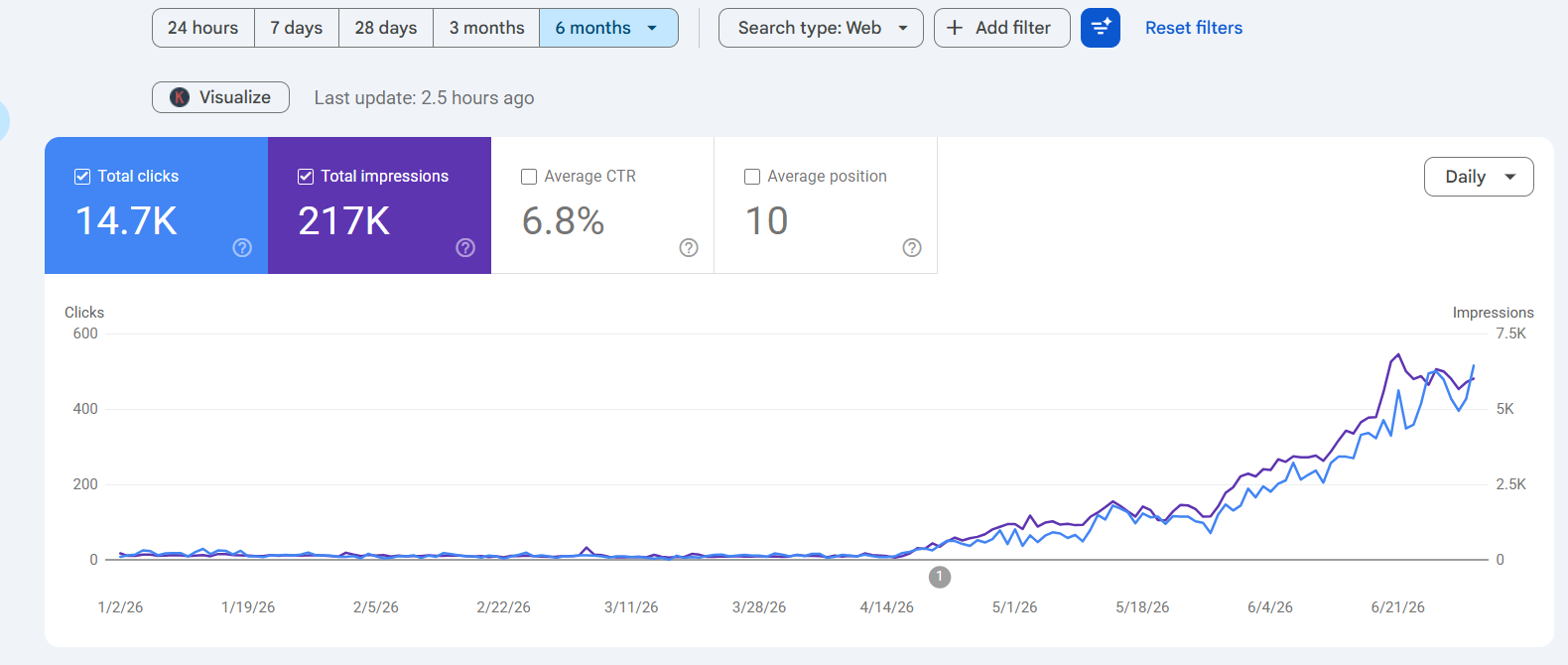
The 4-month SEO campaign produced significant improvements in organic search visibility and website activity.
Organic Search Growth
According to Google Search Console, the latest 3-month period generated:
1.12K clicks
Compared with 164 clicks during the previous 3-month period.
That’s approximately a 583% increase in organic clicks.
114K impressions
Compared with 17.2K impressions previously.
That’s approximately a 563% increase in impressions.
Average Position
Average position improved from:
7.6 → 7.0
This indicates an improvement in overall organic ranking performance.
| SEO Metric | Previous Period | Latest Period | Change |
|---|---|---|---|
| Organic Clicks | 164 | 1.12K | ~583% ↑ |
| Impressions | 17.2K | 114K | ~563% ↑ |
| Average Position | 7.6 | 7.0 | Improved |
| CTR | 1% | 1% | Maintained |
AI Search Visibility
The project also produced measurable visibility within AI-powered search.
The AI performance dashboard recorded approximately:
1K AI Citations
with an average of:
3 Cited Pages
The citation data tracks visibility from Microsoft Copilot and its partner ecosystem.
This demonstrated that the website’s content was not only gaining visibility in conventional search, but was also being discovered and referenced within AI-generated experiences.
For me, this was an important indicator of how SEO is evolving.
Traditional SEO measures:
Rankings → Impressions → Clicks
AI SEO adds another layer:
Content → AI Understanding → Citation → Brand Discovery
Website Engagement
The increase in search visibility was also reflected in website analytics.
Google Analytics showed:
406 Active Users
↑ 20.5%
481 Sessions
↑ 30.4%
2.7K Events
↑ 49.3%
The increase in event activity was particularly encouraging because it showed that engagement was growing alongside traffic.
The objective wasn’t simply to generate impressions.
It was to generate visibility that translated into real website activity.
The Growth Journey
The performance trend throughout the project showed a clear upward trajectory.
Organic search activity increased significantly toward the later stages of the measured period, while AI citations also showed recurring spikes and growth.
This reinforced the importance of treating SEO as an ongoing system rather than a one-time optimization task.
The process was:
Audit → Research → Optimize → Create → Measure → Improve
I continuously used performance data to identify the next optimization opportunities.
Impact
The project helped transform the website’s search presence across multiple discovery channels.
Traditional Search
1.12K clicks
114K impressions
Improved average position
AI Search
~1K citations
3 average cited pages
Website Engagement
406 active users
481 sessions
2.7K events
The result was a broader and more sustainable search strategy that considered both traditional search engines and AI-powered discovery platforms.
What I Learned
SEO is no longer just about rankings
A page ranking in Google is only one part of the modern search ecosystem.
Today, visibility can happen through:
- Search results
- Featured results
- Product discovery
- AI-generated answers
- Citations
- Content recommendations
This project reinforced the importance of optimizing content so that it can be understood and surfaced across multiple discovery systems.
Technical SEO creates the foundation
Content optimization becomes much more effective when the underlying website is technically accessible, crawlable, and logically structured.
Data should drive SEO decisions
Instead of making assumptions about what might work, I used Search Console, GA4, Ahrefs, Semrush, and crawling data to identify opportunities and measure outcomes.
AI search requires a different mindset
AI SEO isn’t simply about inserting more keywords.
It requires creating content that is clear, authoritative, structured, useful, and easy for machines to understand and reference.
Final Outcome
Over the 4-month project, I combined technical SEO, keyword research, content strategy, on-page optimization, structured data, internal linking, analytics, and AI SEO/AEO to build a stronger organic search presence for an e-commerce website.
The project resulted in:
~583% growth in organic clicks
~563% growth in search impressions
Improved average search position
~1K AI citations
20.5% growth in active users
30.4% growth in sessions
49.3% growth in events
More importantly, the project demonstrated how a modern SEO strategy can connect technical optimization, content, search visibility, AI discovery, and user behavior into one measurable growth system.
My Contribution
Role: SEO Specialist
Project Duration: 4 Months
Industry: E-commerce
Focus: Technical SEO · Content SEO · On-Page SEO · Keyword Research · Schema · Internal Linking · AI SEO · AEO · Analytics
Tools: Google Search Console · GA4 · Ahrefs · Semrush · Screaming Frog